
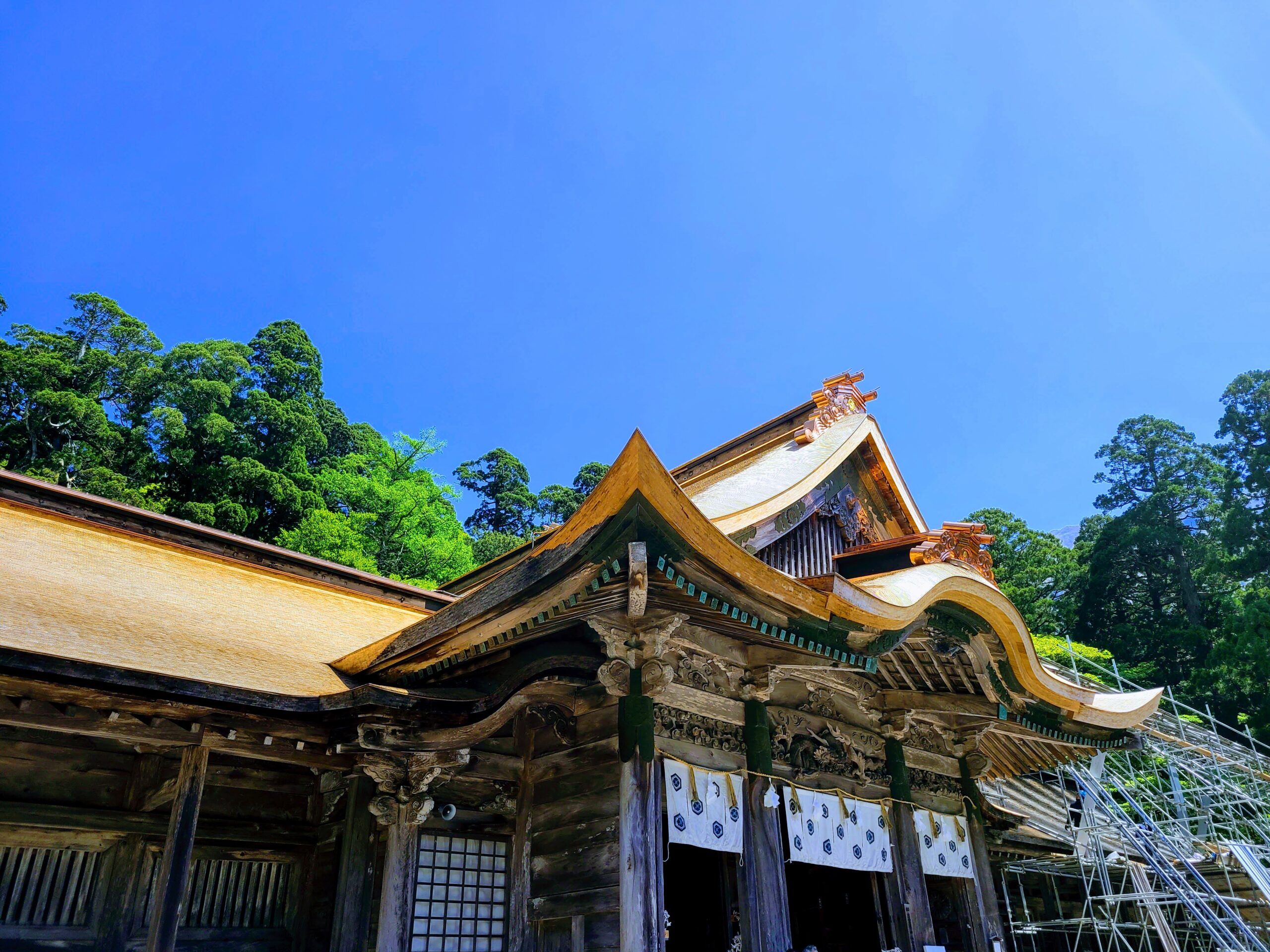
“Ōgamiyama” is an old name for Mt. Daisen, the sacred mountain on which the shrine stands.
The earliest written record of Mt. Daisen appears in the Izumo no Kuni Fudoki,
compiled in the early 8th century during the Nara period. In the section known as
“Oube Kunibiki no Jo, Article 7,” the mountain is described as “Ōgamidake,”
a mighty peak that served as the stake anchoring the divine rope used to pull the
land closer—a myth associated with the Kunibiki legend. In this account,
Ōgamidake (also called Kagamidake) is identified as the mountain located in
Hōki Province, corresponding to present-day Mt. Daisen.
In the Shoku Nihon Kōki, in the entry for the second month of Shōwa 4 (837),
the deity of Mt. Daisen is recorded as receiving the court rank of Junior Fifth Rank, Lower Grade.
Later, in the Nihon Montoku Tennō Jitsuroku, the entry for the eighth month of Saikō 3 (856)
notes that the Daisen deity was elevated to Senior Fifth Rank, Lower Grade.
In the entry for the fourth month of Jōgan 9 (866), the rank is further recorded as
Senior Fifth Rank, Upper Grade.
Additionally, the Engishiki Jinmyōchō (927) lists the shrine as
“Ōgamiyama Shrine of Aimi District, Hōki Province.”
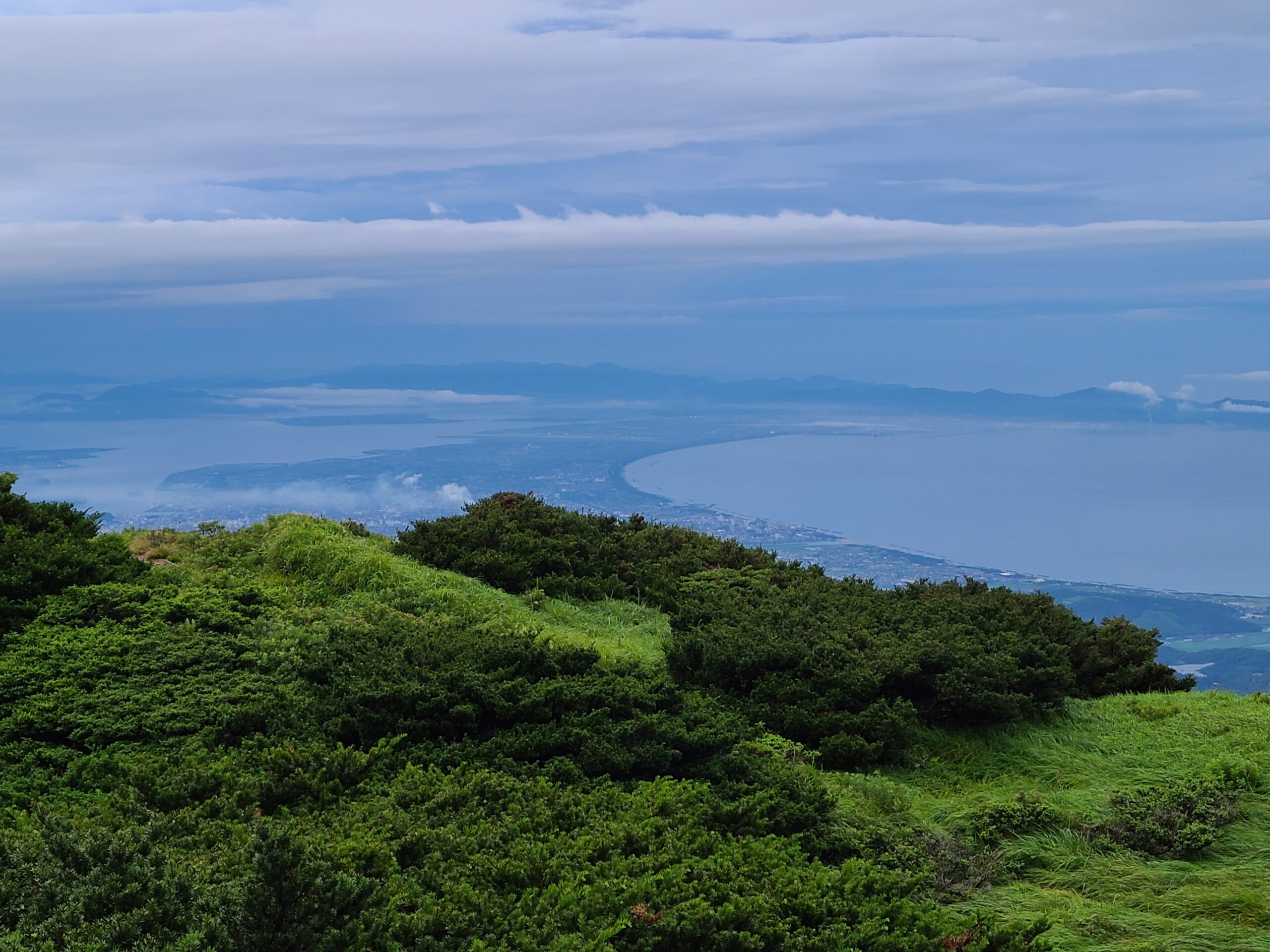
Ōkuninushi-no-Mikoto, the principal deity enshrined here, is said to have
used Mt. Daisen as his base when planning the formation and governance of the land.
According to the entry for Sahimeyama Shrine in the Shingi Shiryō,
“Long ago, Ōkuninushi-no-Mikoto, Sukunahikona-no-Mikoto, and Suseri-hime-no-Mikoto
dwelt at Ōgamiyama in Hōki Province, and from there came to Yura in Izumo.”
It is traditionally said that the deities stood upon the summit of Mt. Daisen,
looked down over the mist-covered, undeveloped land from above the clouds,
and discussed the creation and ordering of the realm.
It is believed that the mountain came to be called “Daisen” in its present form sometime after the Heian period.
As the highest peak in the Chūgoku region, Mt. Daisen rises with an independent and graceful form, and has long been revered as a sacred mountain where the divine resides.
Its divine presence must have been awe‑inspiring not only to those who lived at its foot,
but also to people who crossed the sea to reach this land.
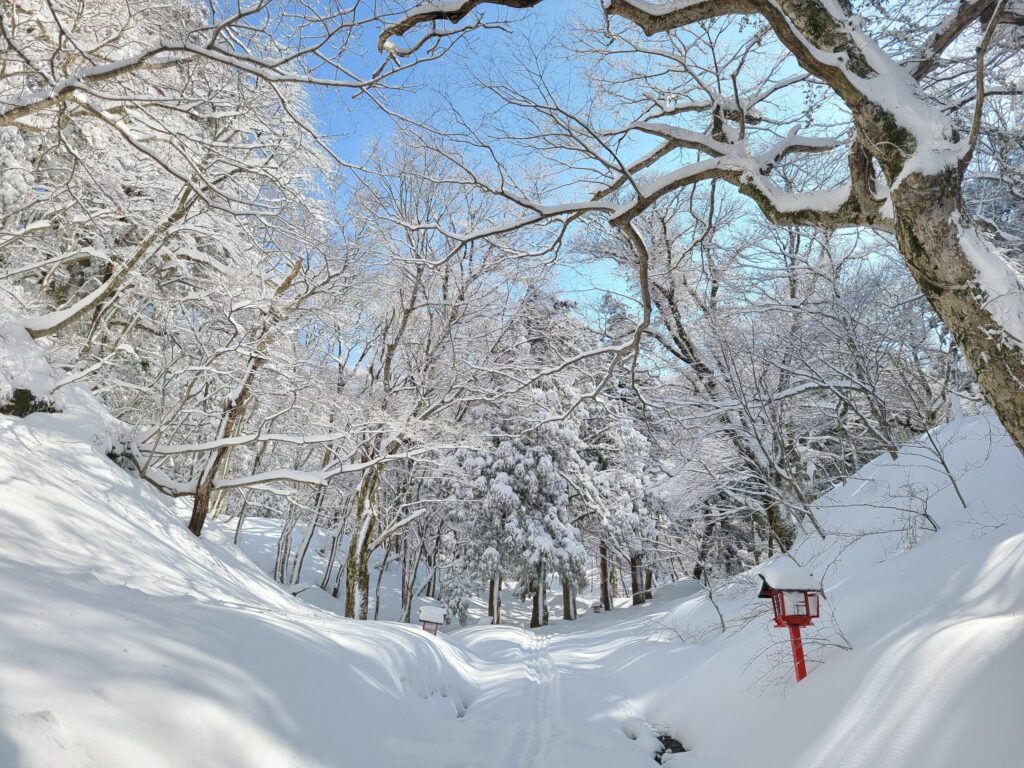
Because the worship facilities on the mountainside of Mt. Daisen were located at high elevation
and received heavy snowfall in winter, it became difficult to conduct rituals and daily service there.
For this reason, a winter shrine was built about 8 kilometers to the west, in the area known as Maruyama,
while summer ceremonies continued to be held at the original site on Mt. Daisen.
The remains of this winter shrine, called Ōgamitani, still exist today.
During the period of Shinbutsu‑shūgō, when Shinto and Buddhism were practiced together,
Shinto priests and temple monks jointly served the shrine. At the Daisen summer sanctuary,
Jizō Bosatsu was enshrined as the Buddhist manifestation (honji-butsu) of Ōnamuchi‑no‑Kami,
and the deity came to be known as Daisen Gongen or Daichimyō Gongen.
Temples and monastic buildings were constructed nearby, and by the Heian and Kamakura periods,
the cult centered on Chimyō Gongen had grown into a major religious power,
said to comprise three main temple complexes, 180 sub‑temples, and as many as 3,000 warrior monks.
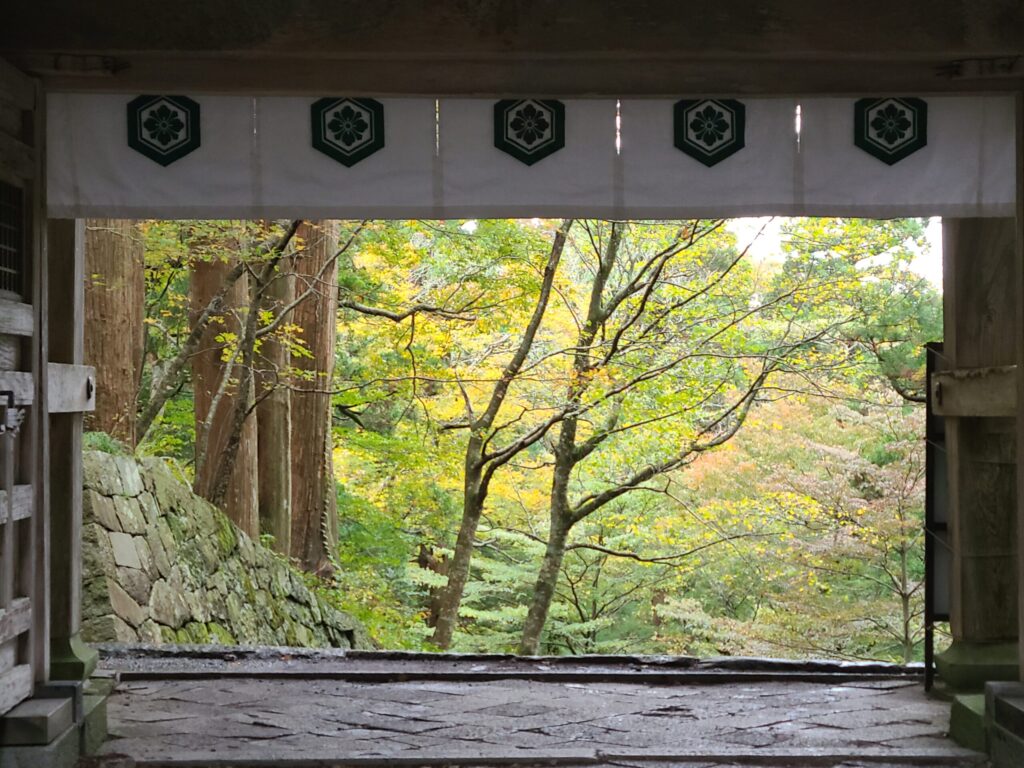
By the late Heian period, the winter sanctuary at Maruyama had become too small
and inconvenient as the religious community grew in size and influence.
The shrine was therefore relocated downstream to the area known as Fukumambaru.
The new complex is said to have included a main hall five bays wide,
a corridor seven bays long, a worship hall thirteen bays long,
and an earthen enclosure, with a Zuishin Gate located several chō to the north.
The shrine is also recorded as having possessed a domain of 1,000 koku,
and the remains of this site can still be seen today.
During this period, the three temple complexes at the Daisen summer sanctuary
frequently came into conflict, and battles among their warrior monks occurred repeatedly.
In the Muromachi period, both the summer and winter sanctuaries were destroyed by fire during armed strife.
Up until that time, Mt. Daisen itself was regarded as the sacred body of the deity,
and no main sanctuary existed at the summer site—only ritual facilities were present.
The fact that there are five deity seats today, despite there being four enshrined deities,
is thought to be a remnant of this earlier tradition.
In 1605 (Bunroku 14), the Daisen summer sanctuary (Chimyō Gongen Shrine) was rebuilt,
and from that reconstruction emerged the present architectural style,
consisting of a main hall, offering hall, and worship hall.
After the sanctuary was destroyed by fire in 1796 (Kansei 8), it was rebuilt in 1805 (Bunka 2),
resulting in the present shrine building. Its interior reflects the style of Shinbutsu‑shūgō,
and the structure is the largest example of Gongen‑zukuri architecture in Japan.
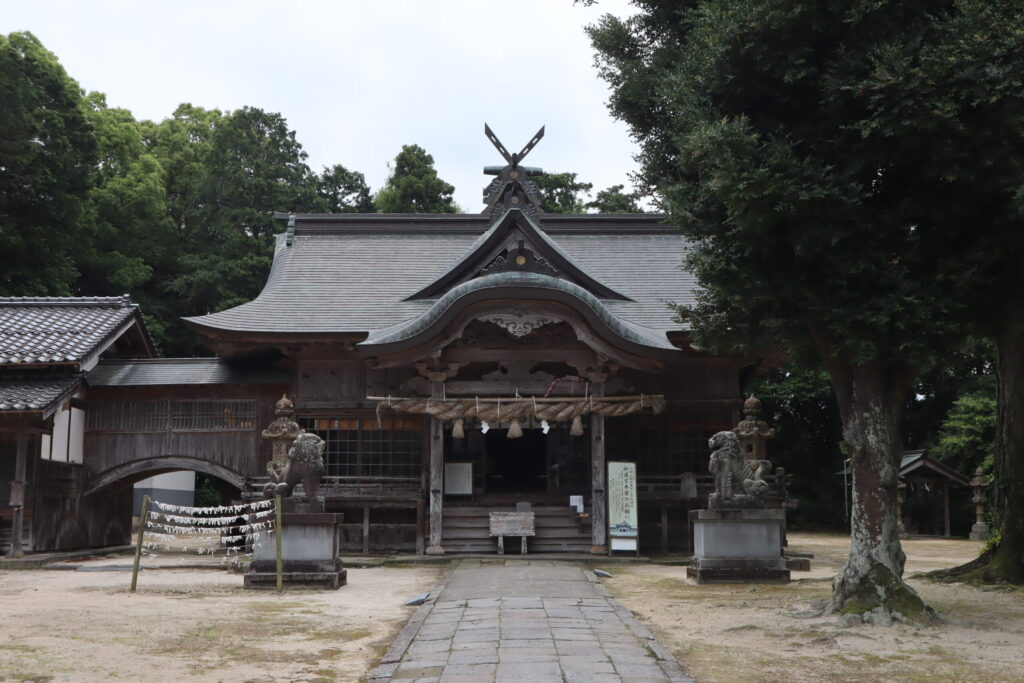
Because the worship facilities on the mountainside of Mt. Daisen were located at high elevation
and received heavy snowfall in winter, it became difficult to conduct rituals and daily service there.
For this reason, a winter shrine was built about 8 kilometers to the west, in the area known as Maruyama,
while summer ceremonies continued to be held at the original site on Mt. Daisen.
The remains of this winter shrine, called Ōgamitani, still exist today.
The successive lords of the region held deep reverence for the shrine,
granting shrine lands and supporting the construction of its buildings.
Kikkawa Hiroie built a magnificent sanctuary on the site of the former Daibonbō
and donated land to the shrine; even after the Kikkawa clan was transferred to Iwakuni,
they continued to offer silver as annual tribute throughout the Edo period.
In the early Edo period, when the Nakamura clan became lords of Hōki Province,
their chief retainer, Yokota Naizen, seized the shrine’s lands.
In response, the monk Gōen petitioned Tokugawa Ieyasu, who granted the shrine
a domain of 3,000 koku.
With this growing influence, the monks of the winter sanctuary were also gathered at the summer sanctuary,
and the priests of the Daisen domain were ordered to conduct the summer rituals.
This effectively separated the roles of priests and monks, leaving the winter sanctuary to be served only by Shinto priests.
As a result, the summer sanctuary came to resemble a Buddhist temple complex,
while the winter sanctuary—known as Ninomiya Daimyōjin—gradually declined.
However, a wealthy farmer named Kōri Hachibee of Nakama-shō took the initiative,
and in 1653 (Shōō 2) the winter sanctuary was relocated to its present site in Odaka,
where new shrine buildings were constructed.
By the mid‑Edo period, it had once again become a highly revered grand shrine of western Hōki.
In the 1778 (Meiwa 5) record *Jinja Kaichō*, there is an entry stating:
“Ninomiya Daimyōjin: seven shaku five sun by two ken square
(note: equivalent to one jō five shaku square),
with subordinate shrines including Monrōfu, Monrōmo, Asamiya Gongen, and Shin-Hachiman-gū.”
The present main sanctuary was constructed in 1808 (Bunka 5),
using timber felled from the domain’s official forests and laborers conscripted from the Aseiri District.
In 1835 (Tenpō 6), the main sanctuary was repaired and a new offering and worship hall was built.
The period of Shinbutsu‑shūgō, during which Shinto and Buddhism were practiced together,
continued for many centuries and lasted into the Edo period.
However, with the Meiji government’s decree separating Shinto and Buddhism,
the winter sanctuary was renamed “Ōgamiyama Shrine” in 1871 (Meiji 4)
and was designated a National Shrine of the Third Rank (Kokuhei Shōsha).
In 1875 (Meiji 8), the summer sanctuary (Chimyō Gongen Shrine) was renamed
“Ōgamiyama Shrine Okumiya,” becoming a Shinto shrine stripped of its Buddhist elements,
and the main shrine and the Okumiya were thereafter regarded as a single shrine.
At that time, the image of Jizō Bosatsu was transferred to the Dainichidō,
which later became the present‑day Daisenji Temple.
At the time of the shrine’s relocation in 1986 (Shōwa 61), new facilities such as the
administrative office and the purification pavilion were constructed at the Odaka main shrine.
Today, it is well known as a “flower shrine,” celebrated for the thousands of hydrangeas
that bloom across its grounds.
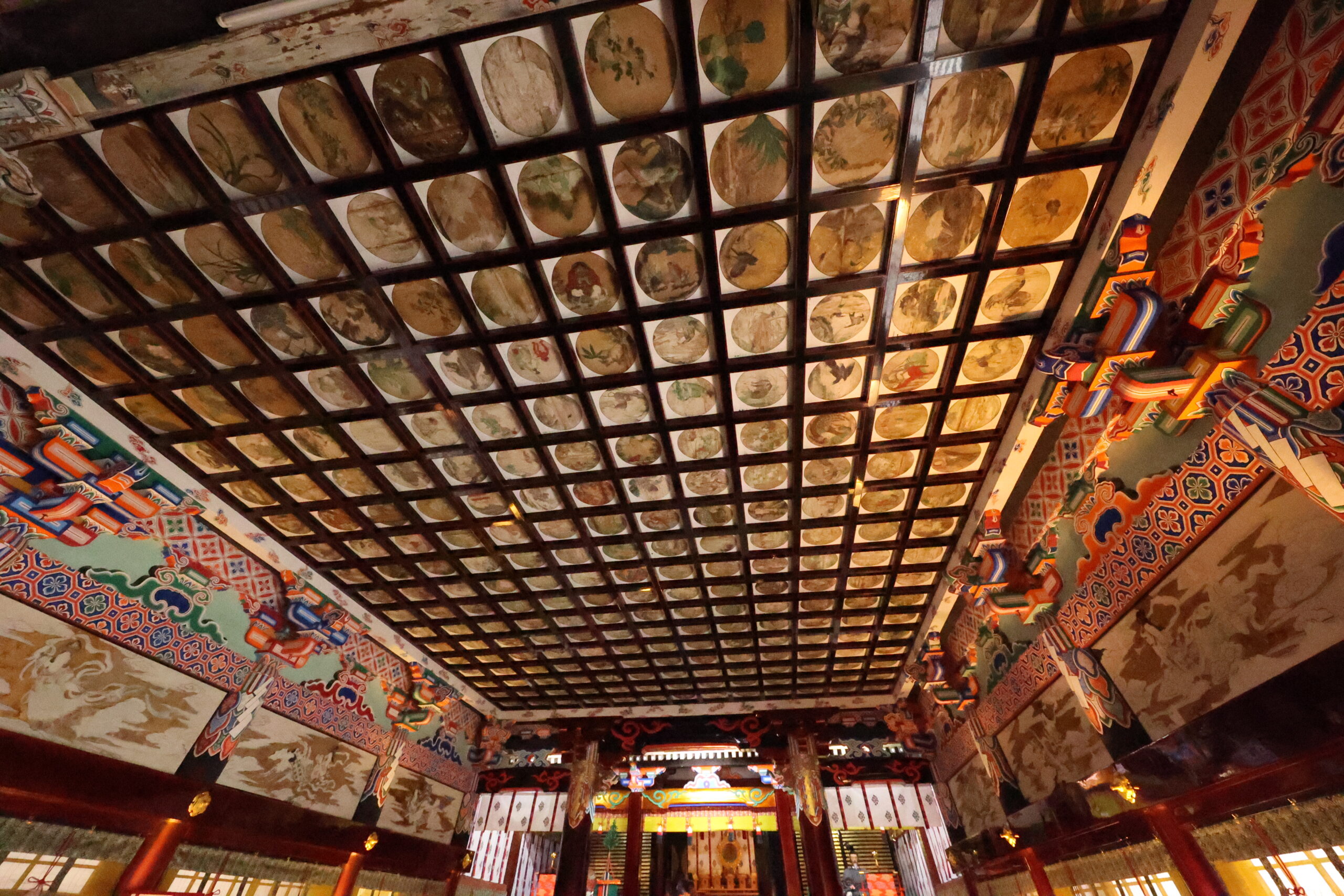
In 1995 (Heisei 7), the inner and outer structures of the Okumiya were restored,
and the interior of the offering hall was renewed with vibrant polychrome decorations
and a reproduction of the Byakudan‑nuri lacquerwork, said to be the largest of its kind in Japan.